
Every enterprise building with AI agents eventually hits the same wall, and it isn’t a model problem. Six months ago it was one pilot agent. Today it’s five, ten, sometimes dozens, built by different teams, on different frameworks, with no shared registry, no consistent identity model, and no reliable way to answer a simple question: which agent touched what, and on whose authority?
That’s agent sprawl, and it’s the reason “harness” has become the word every AI platform vendor is suddenly using. This is the detailed version of the argument behind our companion capability deck, plus what building one ourselves actually taught us.
RELATED READ: From Agent Sprawl to Compounding Value: Why AI Orchestration Is the Only Strategy That Scales
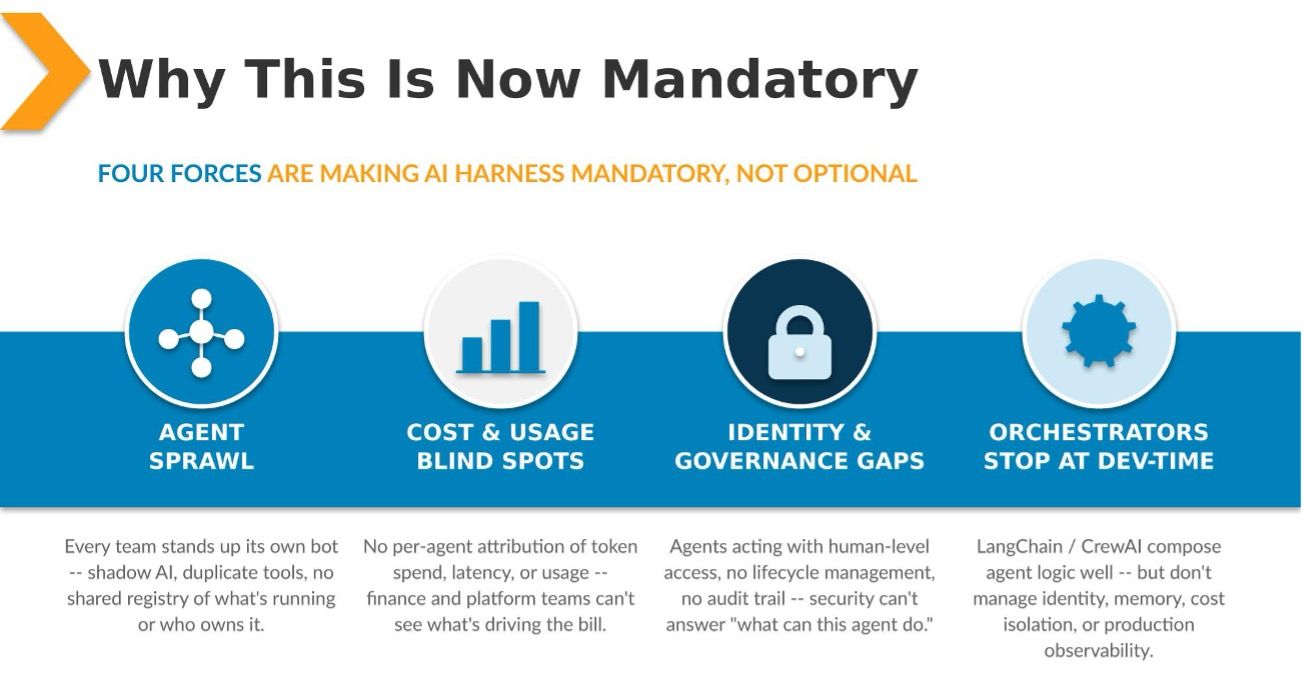
Why Orchestration Isn’t a Harness
LangChain and CrewAI (and similar frameworks) are genuinely good at composing logic — chaining tool calls, coordinating multi-agent workflows, managing prompts. But they are development-time frameworks, not run-time control planes. Out of the box, neither one tells you which verified identity a call ran under, meters cost per agent, or keeps a durable, queryable audit trail across sessions. That gap is exactly what harness platforms — Amazon Bedrock AgentCore, Microsoft Agent 365 with Azure AI Foundry Agent Service — are built to close, by making five capabilities first-class and managed instead of hand-rolled: Runtime, Gateway, Memory, Identity, and Observability. The vendor changes; those five don’t.
Building One Actually Helped Prove It
We didn’t take this on faith. We built two independent agents on AWS Bedrock AgentCore ourselves, end to end, before ever proposing this approach to a client. What that proved, in business terms:
- Faster time-to-value. We’ve already worked through the setup issues that typically slow down a first-time agent deployment, so a client engagement starts past the trial-and-error phase, not in it.
- Governance built in from day one. Every agent request runs through a verified identity check — access control isn’t a “phase two” add-on, it’s there before the first production call.
- Role-based access control, proven — not just diagrammed. The same clinician-vs-patient, admin-vs-viewer separation regulated industries require has been built and tested end to end, not just designed on a whiteboard.
- Full auditability out of the box. Every agent action is traceable, giving compliance and security teams a straight answer to “who did what, and were they allowed to” without bolting on extra tooling later.
- Lower risk, less rework. The configuration and permission mistakes that commonly cause expensive delays later in a project were found and fixed in our own build — not on the client’s clock.
- A validated blueprint, not a first-time experiment. Because we proved this pattern ourselves first, clients get a repeatable approach backed by hands-on delivery experience, not a proposal built on theory.
A Four-Stage Path From Idea to Operating Model
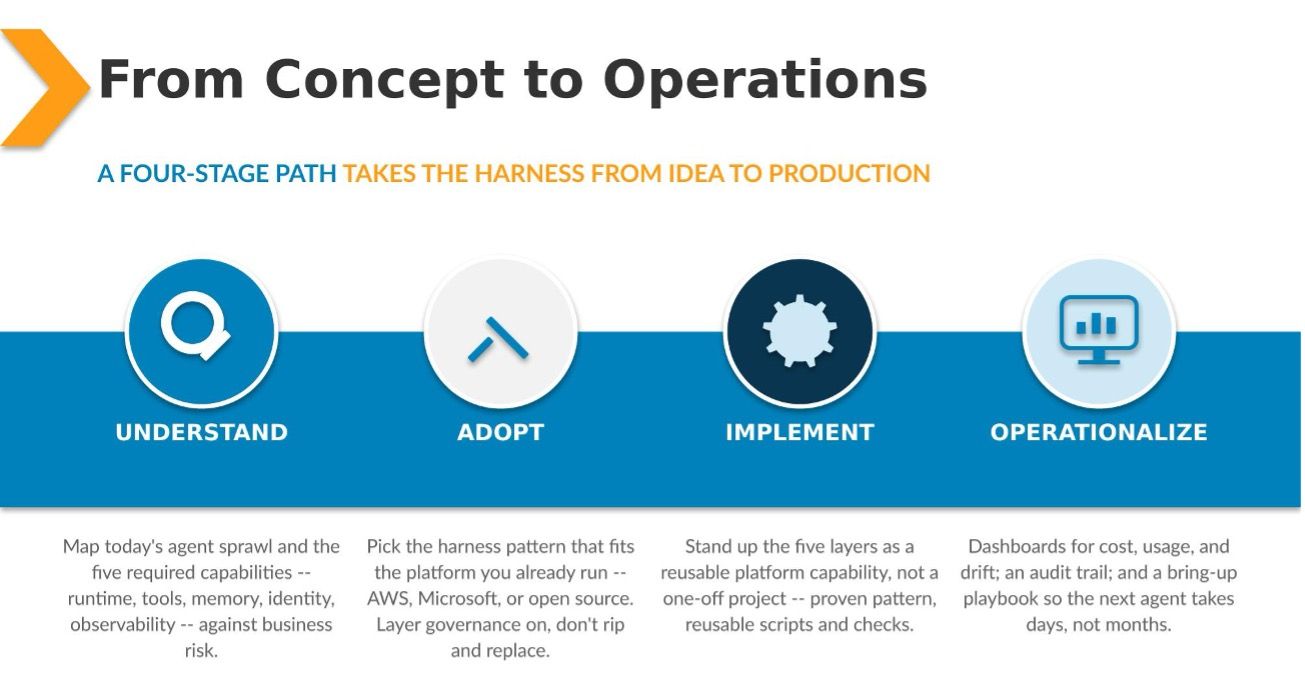 Understand: map where agent sprawl already exists and score it against the five capabilities above. Adopt: pick the harness pattern that matches the platform you’ve already invested in — layer governance in, don’t rip anything out. Implement: stand up the five layers as a reusable platform capability, not a one-off integration for a single agent. Operationalize: instrument dashboards for cost, usage, and drift, and keep an audit trail, so the harness stays governed after go-live instead of becoming next year’s sprawl.
Ready to Build Yours?
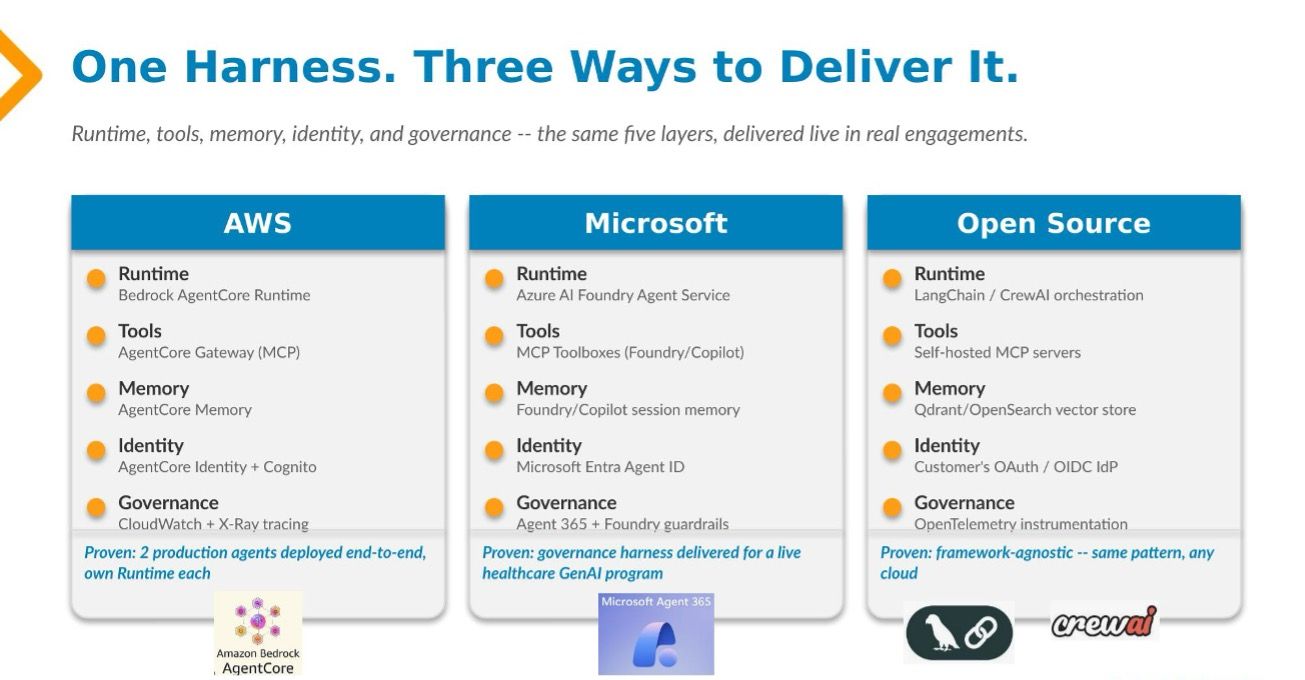
One harness, three ways to deliver it, depending on where you’ve already made a platform bet: AWS Bedrock AgentCore, Microsoft Agent 365 with Azure AI Foundry Agent Service, or a self-hosted open-source stack (LangChain/CrewAI orchestration plus your own identity and observability layer). All three solve the same five problems — the right one is whichever matches what you’ve already committed to.
Curious where your own agent estate stands on sprawl? See Presidio’s AI solutions to learn how we help enterprises adopt this the right way.
This reflects hands-on build work in a sandboxed AWS learning environment. The outcomes above were proven end-to-end in our own build; resource names and figures shown are for illustration only.

Vidhya Sivakumar
Vidhya Sivakumar is a technology leader and builder-practitioner with nearly three decades of experience across software engineering, cloud transformation, data platforms, and AI/ML. Having held leadership roles at Motorola, IBM, Microsoft, AWS, and Presidio, she turns complex business challenges into practical, technology-driven outcomes, and is an active voice in the tech community through thought leadership, speaking, and mentorship.