
The Thesis
Most enterprises already believe their data is ready. They have a governed warehouse, curated models, dashboards the business trusts, and years of cleanup behind them. By every standard our industry has used for a decade, that data is considered ready.
Then the AI pilot stalls, and nobody can quite say why. The model is fine. The platform is fine. The data has passed every quality check. Yet the agent hallucinates a metric, joins the wrong tables, or cannot find the one dataset that would have answered the question.
The reason is not quality; it is that the consumer has changed. Data that is ready for BI is not automatically ready for AI, because a dashboard is read by a person who fills the gaps, while an agent fills nothing.
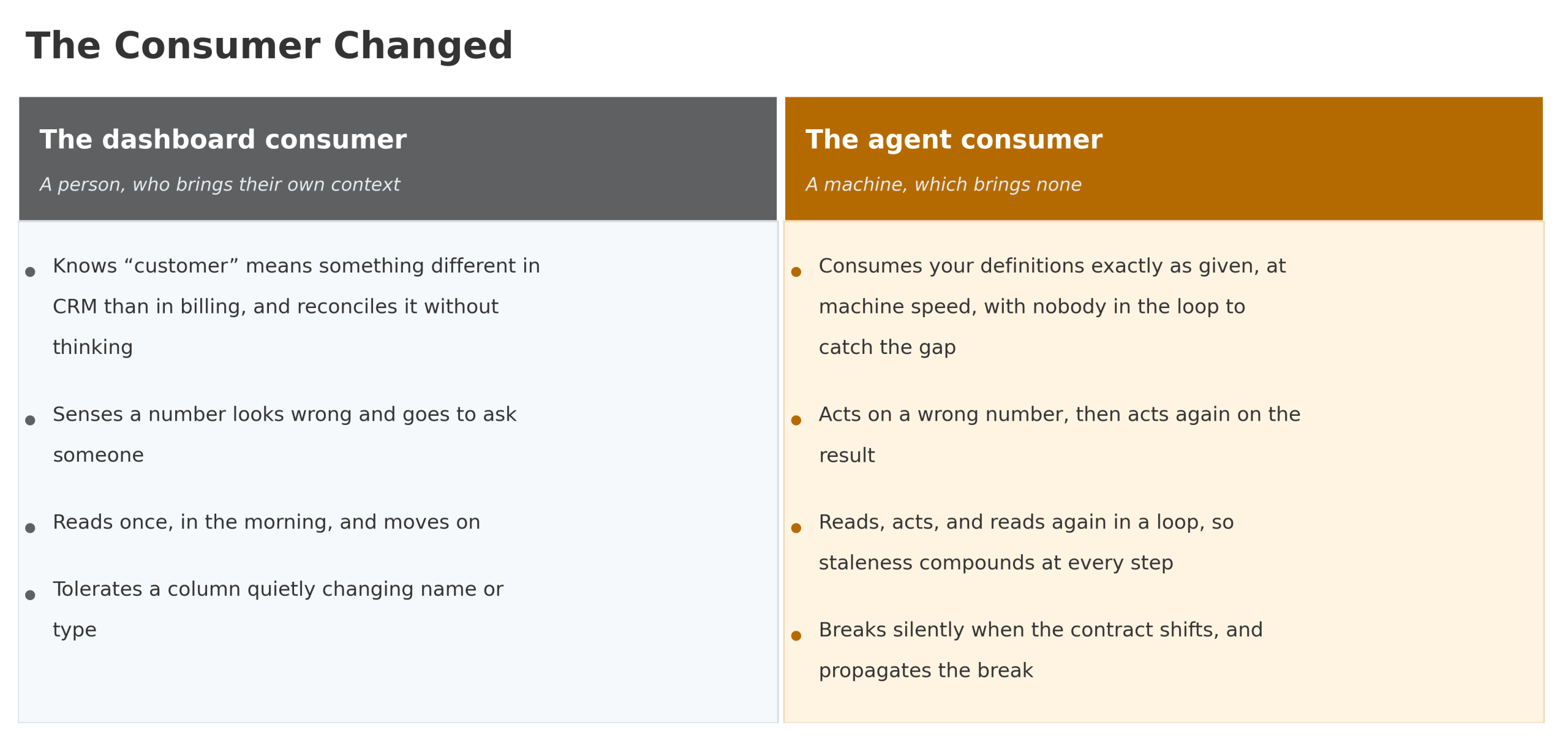
“AI-ready” is not simply a more refined version of “BI-ready.” It represents a different set of qualities: being context-ready and agent-ready, rather than just clean and modeled.
Why a Profile, Not a Score
Readiness is not binary, nor is it uniform across an organization. A single company may be AI-ready in one domain and barely BI-ready in another. Treating readiness as a single grade conceals the very gaps that can derail AI programs. Framing it as a linear climb also misleads customers into thinking they are “at the bottom,” which is neither accurate nor beneficial.
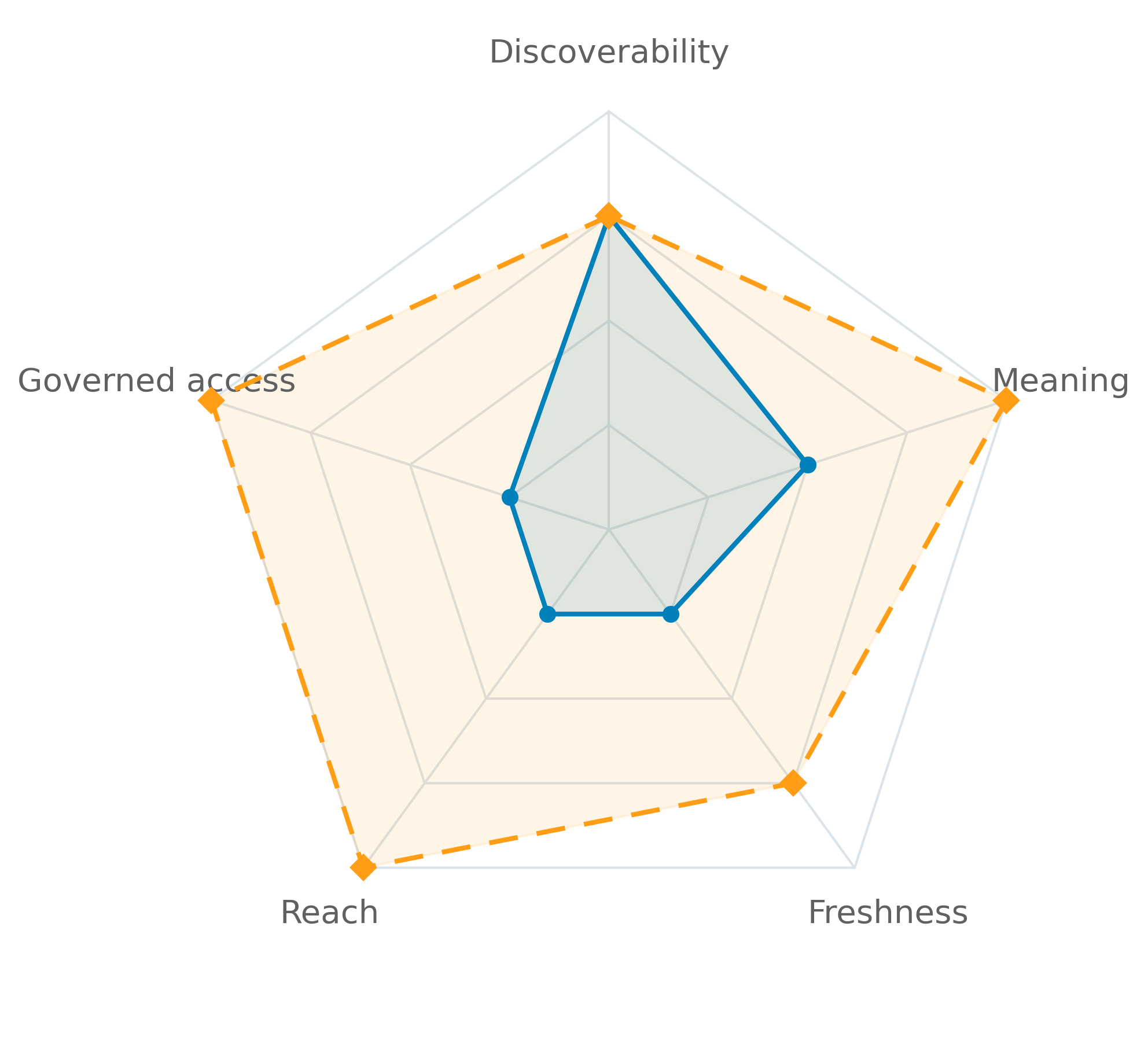
A better model treats readiness as a set of independent dimensions that you measure and move separately. A domain doesn’t fit into a single score; it has a unique shape—strong on meaning, thin on freshness, blind to unstructured data. That shape tells you exactly where to build and where to avoid wasting effort. These dimensions are not sequential. Governed access only becomes important once there is meaningful, reachable data worth protecting, but you don’t need to achieve meaning before adding freshness, nor do you have to wait for freshness before cataloguing unstructured content. The order is determined by your use case, not by a predetermined sequence.
The distance between a domain’s current shape and the shape required by its AI ambition is known as readiness debt, and it is almost always invisible until a pilot encounters it. Most enterprises score low on freshness, reach, and governed access, even as their AI roadmaps quietly assume that all five dimensions are strong.
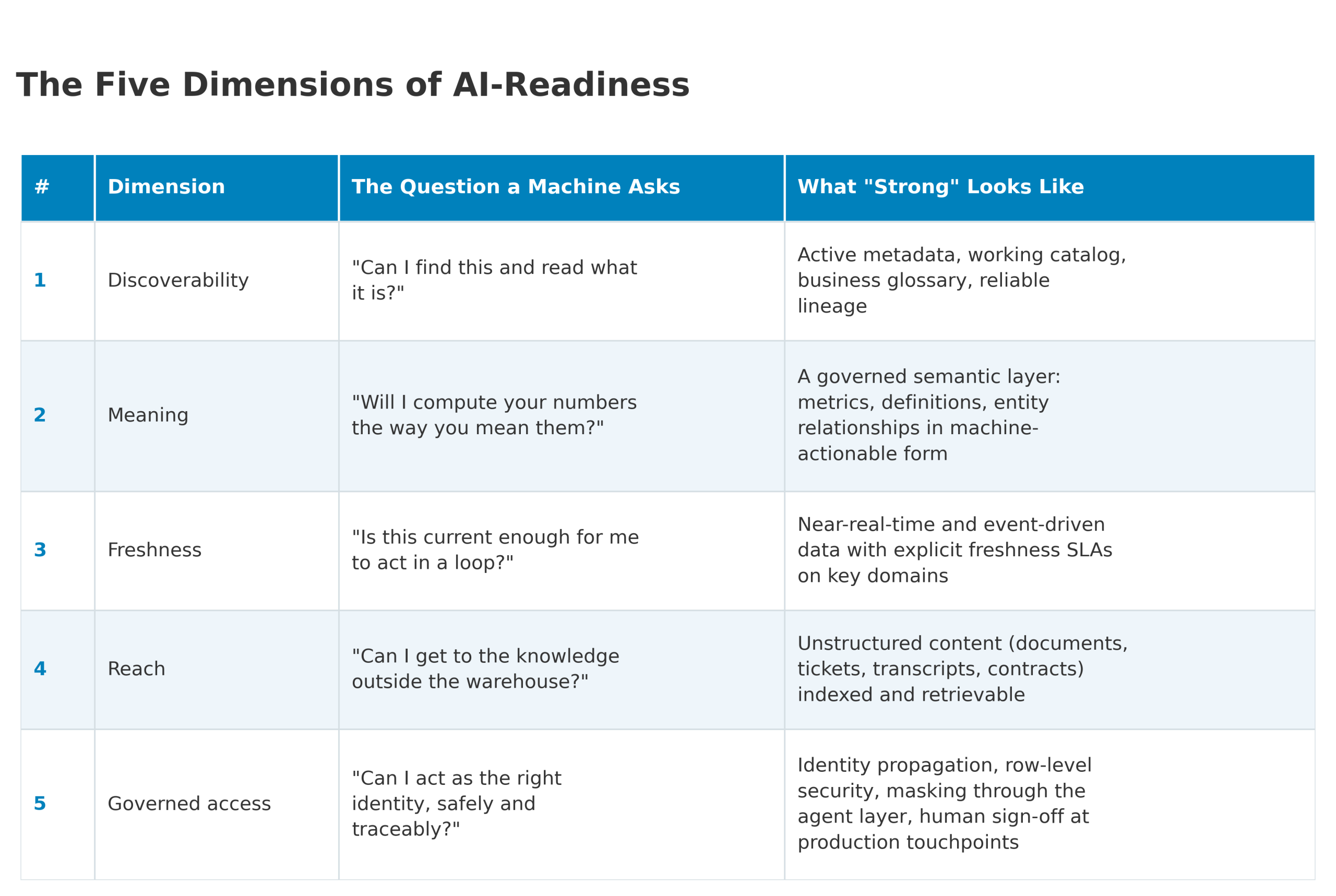
The Five Dimensions of AI-Readiness (the measurement lens)
Each dimension addresses a specific question that a machine must answer—questions that a human consumer never had to consider. By measuring each dimension on its own scale, from absent to foundational to governed to agent-grade, you obtain five honest assessments instead of a single overall verdict.
A domain reads as a shape, not a rung
Each domain is evaluated by comparing its current profile to the profile required by its use case. The gap between these two shapes is the readiness debt. For example, a retrieval assistant needs Reach and Meaning, but not necessarily Freshness; an autonomous agent, on the other hand, requires all five dimensions.
The Anatomy of an AI-Ready Data Product (the build lens)
The dimensions show where a domain currently stands. These five components are essential for advancing the data product. A data product is not AI-ready simply because it is clean; it is AI-ready when a machine can find it, trust it, understand its meaning, reason across its connections, and act on it safely. Each of the five components guarantees one of these capabilities.
Find → Trust → Understand → Reason → Act
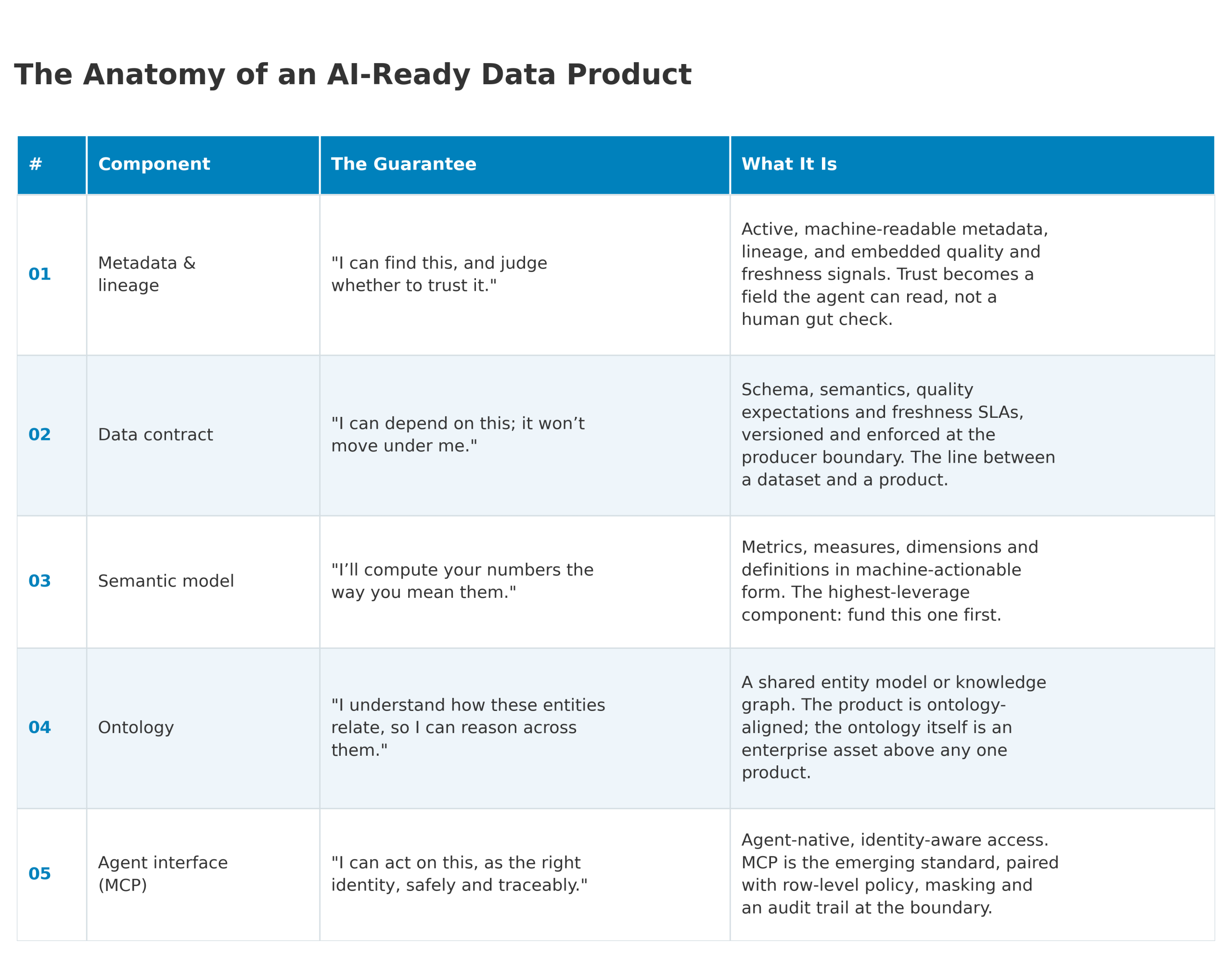
Trust is not a sixth box. It lives within metadata, such as telemetry that the product maintains about itself. Access without identity is the fastest way to turn an AI-ready product into a breach, which is why component five carries two promises, not one.
Measure the Dimensions. Build the Components.
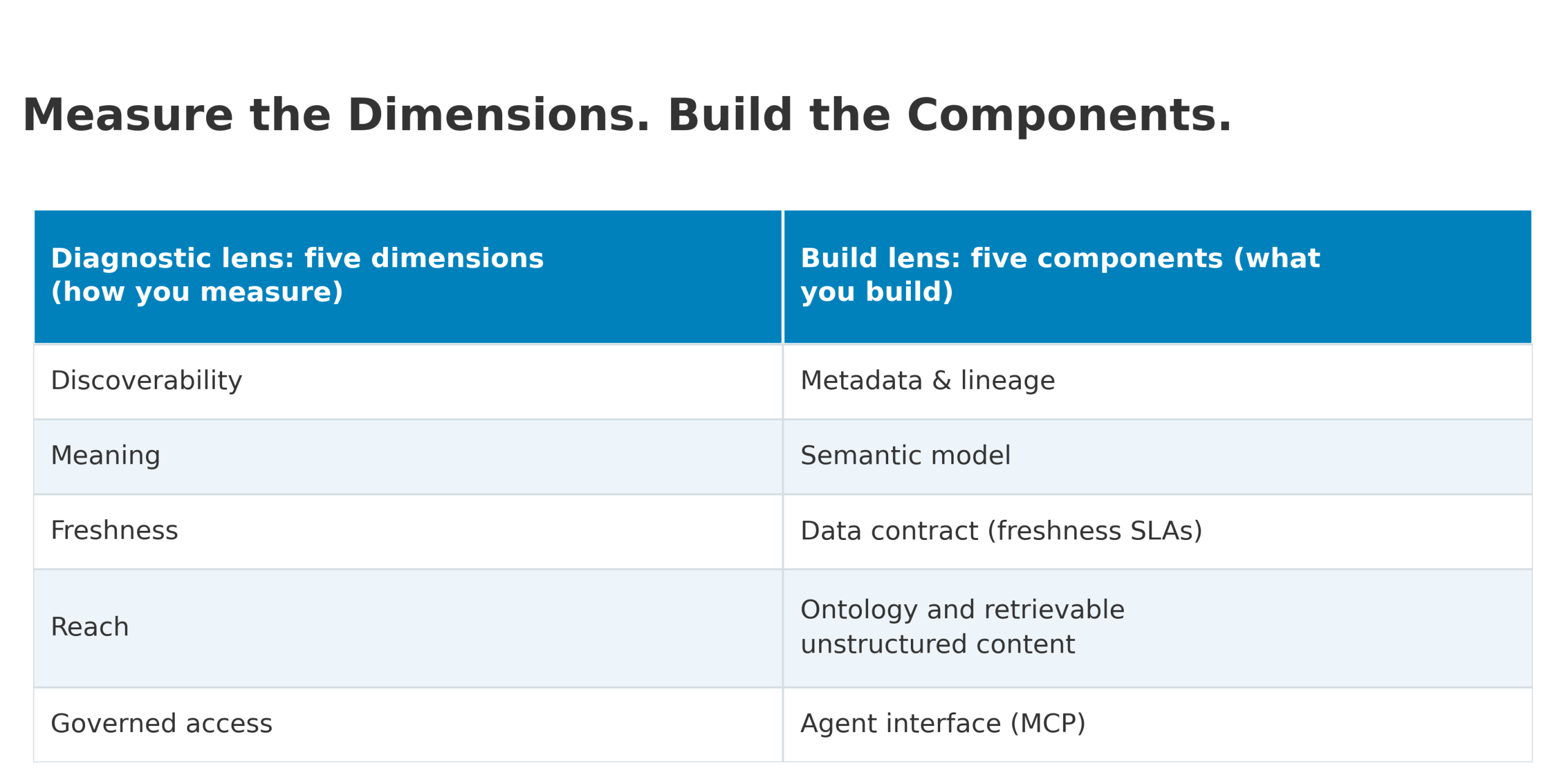
These are two perspectives on the same concept, which is what allows this point of view to do what most cannot: show a client both how we assess readiness and what “good” actually looks like. You measure a domain’s readiness using the five dimensions, and you advance those dimensions by building the five components.
Two Things Must Strengthen Across Every Dimension
The dimensions describe what is added. However, two properties must deepen everywhere, or the entire framework collapses.
Quality and observability
In a report, a wrong number is typically caught by someone who knows better. In an agentic pipeline, however, it slips silently through multiple steps until it surfaces as a decision nobody can trace. Automated reconciliation, validation, and monitoring are not features of a single dimension—they are requirements that span all five.
Governance
For years, governance was considered a brake—a tax paid to keep auditors satisfied. In an AI world, the catalog, lineage, definitions, and quality scores become the very context an agent queries to produce a good answer. Governance stops being AI’s brake and instead becomes its engine.
How to Use This as a Diagnostic
This model is designed to be put in front of a client, not simply admired. It becomes actionable through a scored assessment, what we call the DataScope Pro style of engagement, in three steps:
- Score by domain, not by enterprise. Customer data might score high on Meaning, while supply chain data might be lacking in Reach. A single blended score would hide both facts, which matter.
- Locate the ambition. Determine the shape each domain’s intended use case actually requires. For example, a retrieval assistant working with policy documents needs Reach and Meaning, whereas an autonomous agent acting on customer records needs all five.
- Measure the gap, and use it as the plan. The distance between the current shape and the required shape is the readiness debt. Express this as specific, buildable components, not as a vague maturity grade. This is what transforms a diagnostic into a roadmap.
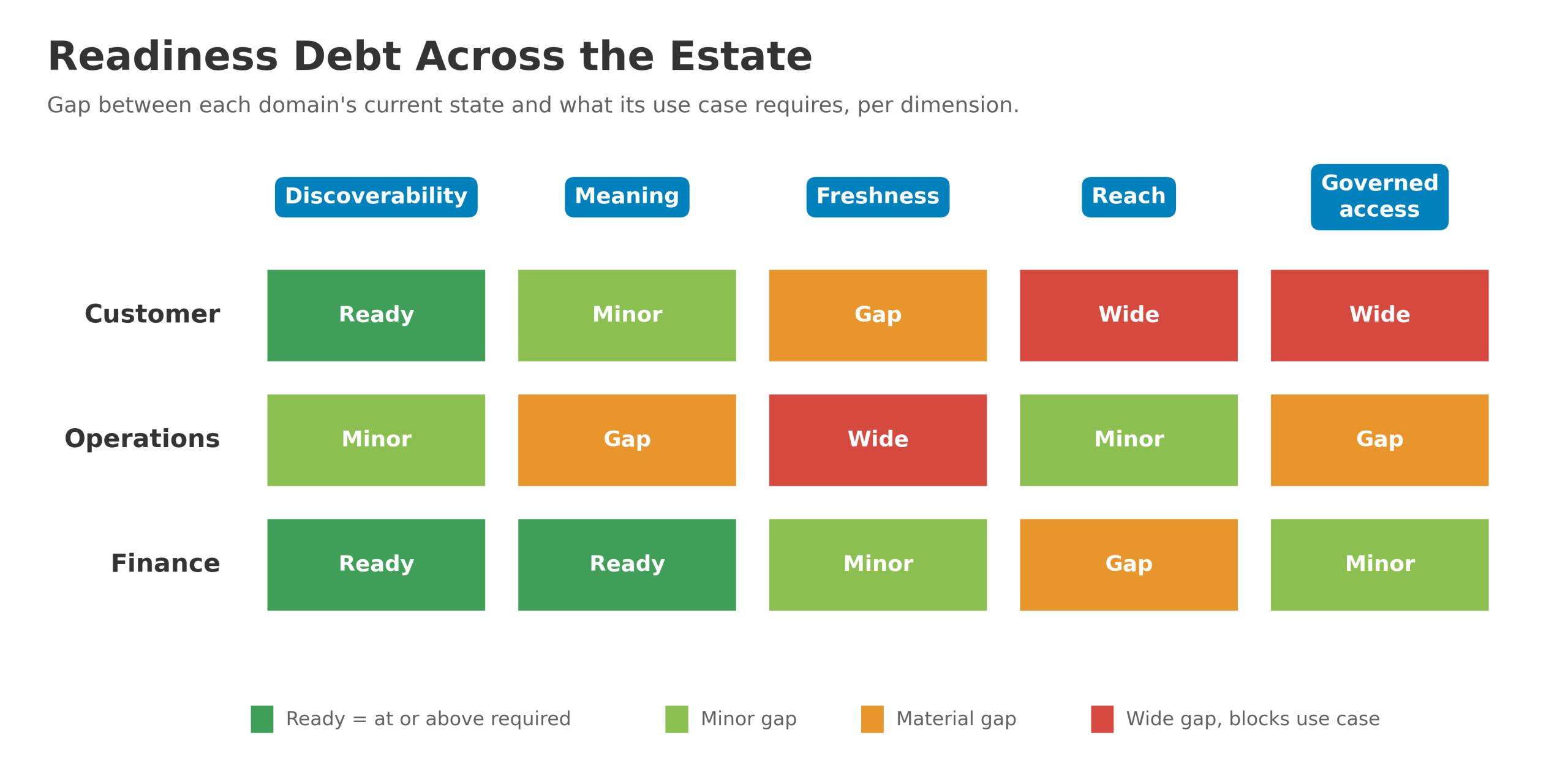
Readiness debt across the estate
Gap between each domain’s current state and what its use case requires, per dimension. This is the roadmap in one view.
Readiness Is Proven by Building, Not by Assessing
A closing point, and a deliberately unpopular one: Many companies today are essentially selling a platform rebuild under the guise of “AI readiness.” Its standard opening move is a multi-month assessment that produces an accurate description of the gap but offers little anyone can actually use. An assessment describes readiness; it does not prove it.
Readiness is demonstrated in the same way a product is proven: by creating one real, governed data product that defines a domain to meet its use case within weeks and then putting it into production. The model shows you where you are and where you need to go. Building reveals the true distance, because gaps only become undeniable when something must run in production instead of sitting on a slide. Your foundation does not need to be complete before AI work begins; it just needs to be sound enough, within the slice you are building, to carry one outcome into production. And it remains human-led: AI may accelerate the work, but an accountable person must sign off before anything reaches production.
Readiness you prove compounds. Readiness you describe in a report expires.
About This Point of View
This point of view comes from Presidio’s Data & Analytics practice. We help organizations move from dashboard-ready to agent-ready across Snowflake, Databricks, and Microsoft Fabric, and we assess where each domain truly stands before anyone commits to an AI outcome. If this framing resonates, or if you see it differently, we welcome the conversation.