
Concurrency is a topic that appears simple on the surface and becomes challenging in real-world systems. Threads, locks, queues, and callbacks often work initially; however, as load increases, complexity grows rapidly. Subtle race conditions, thread starvation, and backpressure issues tend to emerge precisely when systems are under stress.
Modern .NET applications increasingly require a safe and efficient way to pass data between producers and consumers, free from the burden of synchronization codes. This is where Channels in C# (.NET) provide a clean and powerful solution.
Channels offer a structured approach to building asynchronous data pipelines, enabling developers to create systems that are fast, scalable, and predictable under load.
In this blog, we will cover:
- What channels are and why they exist
- How they differ from traditional queues
- Core concepts and patterns
- Practical examples
- When channels are the right choice
What Are Channels in .NET?
Channels are part of the ‘System.Threading.Channels’ namespace and provide a thread-safe, asynchronous data pipeline for passing messages between producers and consumers.
At a high level, a Channel is:
- A shared conduit for data
- Written to by one or more producers
- Read by one or more consumers
- Fully asynchronous and lock-free under the hood
Unlike basic collections or traditional queues, Channels are specifically designed for high-throughput, async-first workloads.
Why Channels Matter in Real Systems
Traditional approaches often rely on the following:
- ConcurrentQueue<T>with polling
- Manual locking (lock, SemaphoreSlim)
- Background workers with custom signaling
While these approaches can work, they tend to push significant complexity onto the developer.
Channels address several common challenges:
- Built-in backpressure
- Async-friendly reads and writes
- Clear completion semantics
- Safe multi-producer / multi-consumer support
In practice, Channels help reduce both code complexity and operational risk.
Core Concepts of Channels
-
Channel, Writer, and Reader
A Channel exposes two primary endpoints:
- ChannelWriter— used by producers to write data
- ChannelReader— used by consumers to read data
This separation enforces correct usage and helps prevent accidental misuse.
var channel = Channel.CreateUnbounded(); ChannelWriter writer = channel.Writer; ChannelReader reader = channel.Reader;-
Bounded vs. Unbounded Channels
Unbounded Channels
- No upper limit on items
- Simple to use
- Risk of unbounded memory growth
Channel.CreateUnbounded();Bounded Channels
- Fixed capacity
- Built-in backpressure
- Safer for high-load systems
Channel.CreateBounded(new BoundedChannelOptions(100) { FullMode = BoundedChannelFullMode.Wait });Bounded channels are generally the preferred default in production environments.
-
Writing to a Channel
Writers use asynchronous methods that naturally respect backpressure:
await writer.WriteAsync(item);When a bounded channel reaches its capacity, producers are suspended instead of overwhelming the system with additional data.
-
Reading from a Channel
Consumers read asynchronously, often using await foreach:
await foreach (var item in reader.ReadAllAsync()) { Process(item); }This pattern is clean, readable, and efficient.
-
Completion and Shutdown
Channels provide explicit completion semantics:
writer.Complete();Once all data has been processed, consumers automatically finish processing. This simplifies graceful shutdown compared to manual signaling approaches.
End-to-End Example: Producer–Consumer Pipeline
Scenario
Process incoming requests asynchronously without blocking the main thread.
var channel = Channel.CreateBounded(50);// Producer _ = Task.Run(async () => { foreach (var request in requests) { await channel.Writer.WriteAsync(request); } channel.Writer.Complete(); }); // Consumer await foreach (var item in channel.Reader.ReadAllAsync()) { await HandleRequestAsync(item); }With minimal code, you can build a safe, backpressure-aware pipeline.
Common Real-World Use Cases
Channels are particularly useful in the following scenarios:
Background Processing
- Job queues
- Event processing
- Log ingestion
High-Throughput APIs
- Request buffering
- Rate smoothing
- Fan-in / fan-out patterns
Streaming Pipelines
- Data ingestion
- Message transformation
- Batched processing
Producer–Consumer Architectures
- Multiple writers and multiple readers
- Controlled concurrency
Channels vs. Other Concurrency Primitives
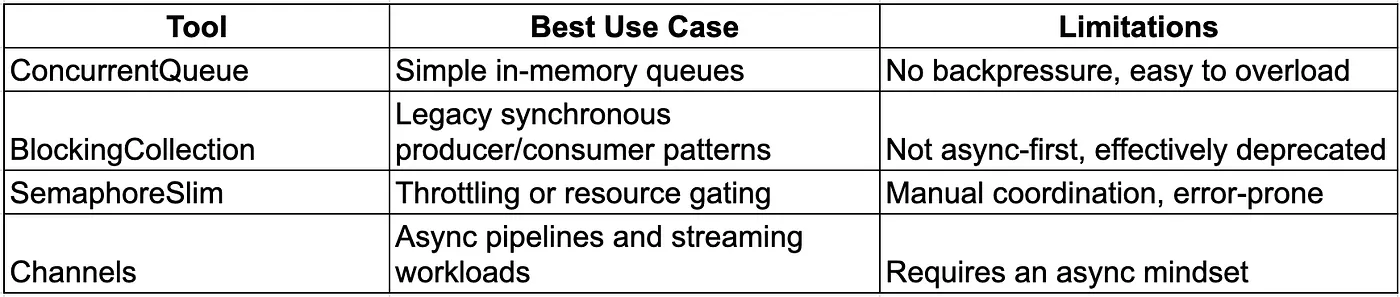
Channels excel when asynchronous workflows and high throughput are critical.
Best Practices
- Prefer bounded channelsin production environments
- Clearly separate producers and consumers
- Handle completion explicitly
- Avoid long-running blocking work inside consumers
- Monitor throughput and queue depth
The Future of Channels in .NET
Channels have become a foundational building block in modern .NET runtimes and libraries. ASP.NET Core and other high-performance components widely use them internally.
As asynchronous and event-driven architectures continue to evolve, Channels will remain a core primitive for building scalable and efficient concurrent systems.
Conclusion
Channels provide a clean, powerful abstraction for building concurrent systems in .NET.
While delivering strong performance, they remove much of the accidental complexity associated with threading, locking, and manual coordination.
For developers building high-throughput, async-first applications, Channels are a tool worth mastering.
Concurrency is challenging. Channels make it manageable.