
We’ve moved beyond the era of “one experience for everyone.” Today, the expectation is clear: every interaction should feel personal, relevant, and intuitive. Hyper-personalization is the evolution that makes this possible—adapting digital products in real time based on user behavior, preferences, and context.
What if the apps you build could understand users the way a human assistant does? What if they could anticipate needs, adjust without being asked, and shape journeys that feel natural? This is no longer science fiction; it’s becoming the new baseline for digital products across industries like streaming, retail, gaming, healthcare, and travel.
Hyper-personalization is not a feature. It’s the future of product design.

1. The Shift: From Personalization to Hyper-Personalization
Personalization used to be simple.
“If a user liked A, show them more of A.”
However, in today’s world, personalization barely scratches the surface. Users expect every digital touchpoint to feel personalized, as if: “This experience is built exactly for me in this moment.”
Modern products are already evolving to meet these expectations:
- The Starbucks app does not just show popular drinks. It predicts your usual order based on time of day, weather, location, and past behavior.
- A gaming platform does not display a fixed lobby. It reorganizes the home screen based on the quests, challenges, or characters you interact with most.
- An e-commerce app reshapes the entire feed, promotions, and UI layout based on your browsing patterns, preferences, and real-time context.
Across industries, including streaming, retail, healthcare, sports, gaming, travel, finance, and other digital experiences, content is no longer being recommended.
Products are now dynamically orchestrating the entire experience around each user.
This shift is the reason hyper-personalization has become one of the most powerful strategic differentiators for the next generation of AI-driven products.
-
What I Learned From Real-World AI-Driven Personalization Initiatives
In several recent opportunities for app development, I encountered a consistent pattern:
Use Case 1: Live Streaming (Sports / Concerts / Events)
A leading multi-device streaming platform wanted to create fan-centric viewing. Instead of everyone seeing the same broadcast interface:
- A fan who follows a specific athlete gets a spotlight feed.
- Stats, angles, and UI tiles shift dynamically.
- The experience feels “tailored,” not “broadcasted.”
Use Case 2: Interactive Digital Platforms (Gaming/EdTech/Fitness)
A large user-interactive platform wanted the home screen to change based on:
- The user’s behavior
- Their past engagement
- Their intensity levels or learning difficulty
- Their goal or risk appetite
Instead of static menus, the platform becomes an adaptive coach.
Use Case 3: Retail & E-Commerce
Retailers increasingly want dynamic product ordering, custom offers, and experience-based bundles, adapting in real time to a shopper’s context, behavior, and intent.
Use Case 4: Healthcare & Well-Being
In patient journeys, hyper-personalization is becoming critical:
- Tailored patient education
- Customized care workflows
- Predictive insights unique to each individual
- Clinician-specific next-best actions
- All enabled through patient profiles and behavioral signals.
Across all these domains, the insight is the same:
Hyper-personalization is not a feature. It is an experience strategy.
-
What Hyper-Personalization Actually Means (And What It Doesn’t)
Most enterprises think they are doing personalization.
But they are doing segmentation:
- “Show this offer to all users in segment X.”
- “Send this recommendation to people interested in Y.”
Hyper-personalization is not a segmentation, and it is an experience.
Hyper-personalization means:
- Real-time decision-making
- Behavioral interpretation
- Context awareness
- Dynamic UI/UX adaptation
- Journey-level personalization (not page-level)
- Every user sees a unique version of the product.
It Does Not Mean:
- One-size-fits-all recommendations
- Static rules
- Manual personalization triggers
- Guesswork based on old data
Hyper-personalization is AI-driven, dynamic, and deeply contextual.
-
Why It Matters: Business Outcomes Across Industries (Condensed)
Consistently drives measurable impact:
- 30–60% increase in engagement—users stay longer because the experience feels personally relevant.
- 20–40% higher conversions—reduced friction and faster decision-making.
- 15–35% improvement in retention—products evolve with the user instead of aging out.
- 15–50% uplift in ARPU/LTV—personalization aligns value with intent.
- Stronger operational efficiency—AI automates decisioning so teams focus on innovation, not manual segmentation.
Hyper-personalization isn’t a UI enhancement; it’s a revenue and growth strategy.
-
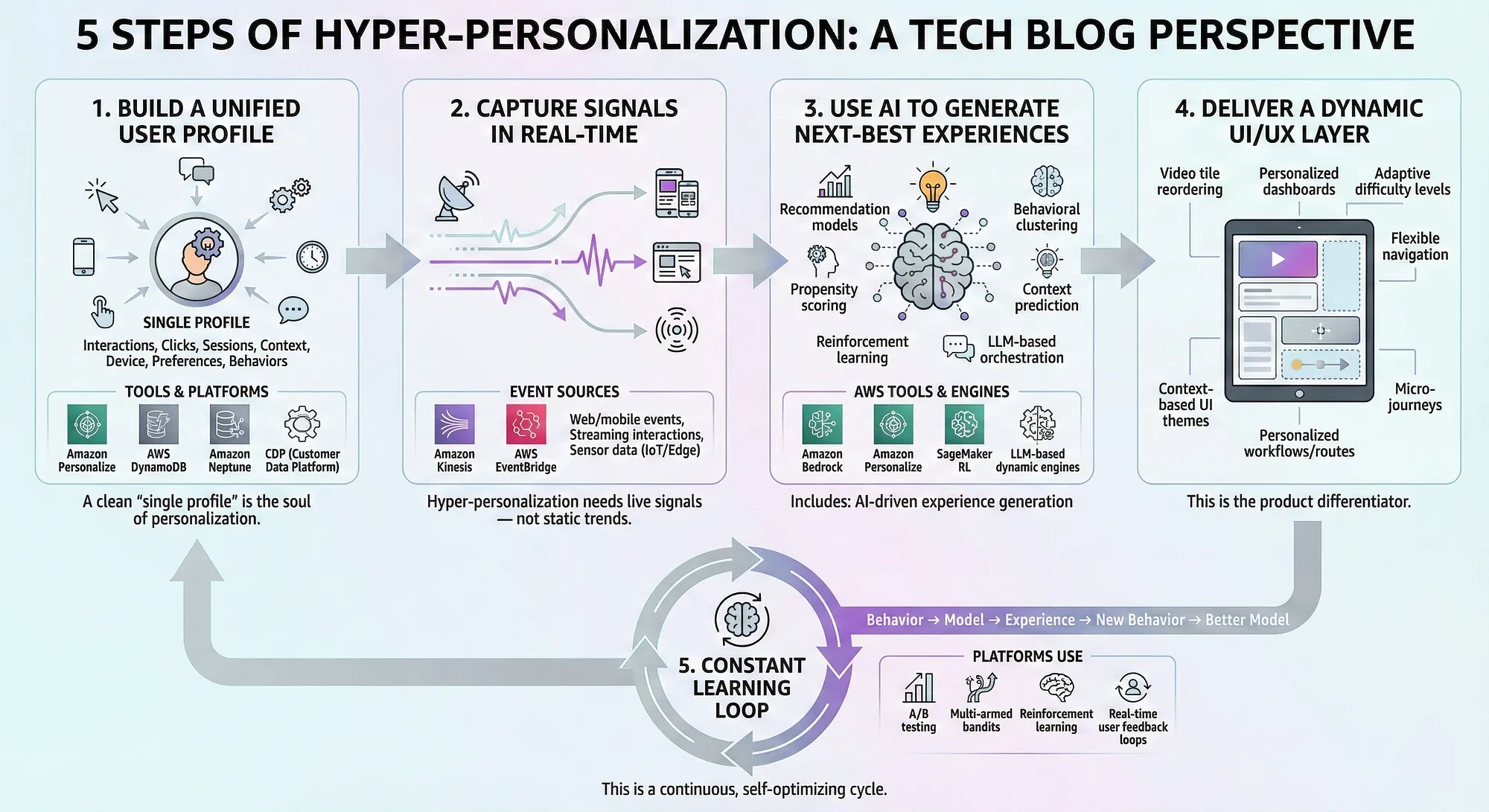
The Strategic Blueprint: How Modern Products Achieve Hyper-Personalization
-
The Future: Where Hyper-Personalization Is Really Headed
Hyper-Personalization Is a Product Strategy—Not an AI Project
Organizations often treat personalization as a feature release or a machine learning initiative.
But true hyper-personalization is a product philosophy:
- It shapes roadmaps
- It drives how experiences are designed.
- It influences what data is collected.
- It dictates how value is delivered.
If hyper-personalization is not embedded in the product strategy itself, it becomes fragmented, inconsistent, and ultimately ineffective.
The UI of the Future Is Built for Variation, Not Uniformity
For decades, design systems focused on consistency—predictable layouts, identical flows, and standardized interactions.
The next generation of products reverses this trend.
The question is no longer “How do we make every user see the same interface?”
It becomes, “How do we design a system where every user can see a different interface—without breaking?”
Products will need:
- Flexible components
- Modular layouts
- Dynamic navigation
- Adaptive surfaces that reconfigure in real time
Design teams must start thinking like systems architects, not page designers.
Hyper-Personalization Requires a Cross-Functional Operating Model
No single team can deliver hyper-personalization.
It demands partnership between:
- Data(signals, profiles, context)
- AI/ML(predictions, next-best actions)
- Product(journeys, value definition)
- Engineering(real-time delivery, scalability)
- Experience Design(adaptive interfaces, dynamic flows)
This is not a siloed initiative—it is a collaborative operating model that aligns teams around individual customer value.
When these teams move together, the transformation is exponential.
-
The Future: Intelligent Experience Orchestration Through AI Agents
Hyper-personalization is now evolving into something much bigger:
AI-driven experience orchestration.
Instead of static recommendations, products will soon have autonomous agents that:
- Interpret signals in real time
- Understand the user’s intent and emotional state
- Decide the next best step across the entire journey
- Reconfigure interfaces instantly
- Act as invisible collaborators, guiding users like digital companions
Think of it as “a personal operating system for every user.”
Across various domains like e-commerce, EdTech, sports, mobility, finance, and healthcare.
The products of tomorrow won’t just personalize. They will adapt, anticipate, and orchestrate.
-
Balancing Innovation with Trust, Privacy, and Compliance
Hyper-personalization creates massive value—but it also amplifies risks around privacy, security, ethics, and cost that product leaders must proactively manage. The question that comes up in every stakeholder review is the same:
“How secure is my data?”
And it’s the right question.
As users increasingly encounter AI-powered systems and agentic browsers that request broad data access (like Comet), skepticism is rising. Hyper-personalization can only succeed if it is built on a foundation of trust.
Here are the core risks and responsibilities teams must navigate:
- Creepiness & trust erosion: Overly precise or sensitive personalization can trigger discomfort. Transparency, consent, and user control are critical for maintaining trust.
- Privacy & secure data usage: Personalization must not require invasive access. Use data minimization, encryption, anonymization, zero-trust access controls, and explicit consent. Personalization should make the experience smarter and not expand data exposure.
- Data quality & relevance: Poor-quality signals lead to irrelevant or incorrect experiences. Strong data hygiene, governance, and real-time validation pipelines are essential—and expensive if neglected.
- Scalability, latency & cost: Real-time personalization increases infrastructure demands.
– Real-time inference can raise compute costs by 25–40%.
– Behavioral event storage can grow by 3–5×within months.
– Low-latency architectures (caching, embeddings, streaming) require continuous optimization. - Fragmented UX: Dynamic UIs can easily become confusing. Personalization must balance adaptability with predictable user mental models.
- Ethical & regulatory risks:
– Do not personalize using sensitive traits (health, race, income, minors).
– Comply with GDPR, CCPA, HIPAA, PCI-DSS, and emerging AI regulations.
– Ensure explanation, consent management, data minimization, and auditability. - Cross-functional alignment: Hyper-personalization spans product, data, AI/ML, engineering, UX, legal, and compliance. Without a unified model, companies often waste 20–30%of personalization investment due to duplicated tools and fragmented roadmaps.
Hyper-personalization only works when it is anchored in responsible data practices, privacy-first design, strong security controls, thoughtful experience design, and cost-aware architecture.
Innovation must evolve hand-in-hand with trust.
The World We Are Moving Toward
We are entering a future where no two users will interact with a product in the same way. Interfaces will adapt in real time, AI agents will negotiate and coordinate across applications, and insights will flow seamlessly into actions—instantly, intelligently, and contextually.
But as products evolve from static tools into adaptive digital partners, our responsibilities as product leaders evolve too.
The next generation of hyper-personalized systems must be built with:
- Responsibility—ensuring that relevance never crosses into intrusion.
- Transparency—helping users understand why AI behaves the way it does.
- Ethical guardrails—preventing personalization around sensitive traits.
- Compliance by design—aligning with GDPR, CCPA, HIPAA, PCI-DSS, and emerging AI regulations from the start.
- User agency—allowing individuals to control how much personalization they want.
Because the real question is no longer “How do we personalize our product?” It is: “How do we build an intelligent system that adapts to each individual—responsibly, ethically, and transparently?”
That is the future of AI-driven products.
And it is much closer than most organizations realize.