
Ask a room of engineering leaders where AI is changing software delivery and most will point to the same place: the Integrated Development Environment (IDE). That’s fair. The AWS AI-Driven Development Life Cycle (AI-DLC) – a methodology where AI directs the workflow and humans approve each step – has put real structure around AI-assisted building, taking teams from business intent to requirements to tested code in a fraction of the usual time, with a human approving each step along the way.
It’s also only half the lifecycle.
Applications spend weeks being built and years being run. The build half now moves at AI speed. The run half, for most organizations, still moves at the speed of whoever answers the page at 3 a.m. That person usually didn’t write the code, wasn’t in the room when the design decisions were made and is starting from a stack trace.
This post looks at the day after deploy: why it’s becoming the real constraint on AI-native development, and why the artifacts AI-DLC already leaves behind may be the most useful thing an operations team has been handed in years.
Why AI-native development needs AI-native operations
Most of the conversation about AI in software has been a productivity conversation, and that story is improving. Google’s 2025 DORA research, drawn from nearly 5,000 technology professionals, found that AI adoption is now associated with higher delivery throughput, a reversal from the year before.
The same research found that delivery instability keeps rising. Researchers tested whether faster recovery could offset it and found no positive result. The 2024 edition had already put a number on it: rising AI adoption was associated with an estimated 7.2% reduction in delivery stability. DORA’s own summary is that AI acts as an amplifier, magnifying whatever strengths and dysfunctions a team already has.
The cost shows up on the balance sheet too. In an IBM survey, 69% of executives said unaddressed technical debt could make some AI initiatives financially unworkable.
Those findings side by side show a clear pattern. More code, shipped more often, landing on an operations model that hasn’t changed much since the pager. Observability investments tell teams what broke. Closing the loop, from alert to root cause to a tested fix, still requires a person every time, and alert volume is growing faster than headcount.
The bottleneck simply moved.
The handoff has always leaked context
Anyone who has worked a production incident knows the error is rarely the hard part. Logs, traces and dashboards will tell you what failed and when. They say very little about what the code was supposed to do, which constraint the original team was protecting or why the retry logic looks the way it does.
That knowledge has always lived somewhere else. In a design doc that wasn’t updated after launch. Or in a wiki page from two reorgs ago. Or in a chat thread no one can find. Or in the head of an engineer who has since moved on. Every build-to-run handoff leaks some of it, and on-call teams spend the first stretch of every serious incident trying to rebuild it.
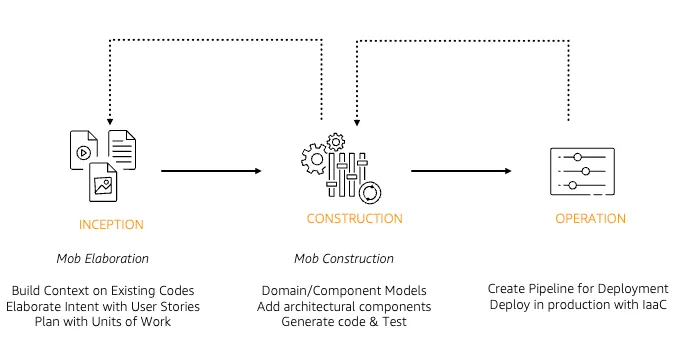
AI-DLC changes the raw material. In Inception, a practice called Mob Elaboration brings the whole team together while AI turns business intent into requirements, user stories, and units of work. People validate each question and proposal as it comes in. In Construction, Mob Construction does the same for architecture, code, and tests, working in bolts: short, focused cycles measured in hours rather than sprint-length weeks. Every one of those sessions leaves a record. The open-source AI-DLC workflows commit the plans, requirements, design artifacts, steering rules, stage records, and an audit trail of human approvals alongside the application code so the work can pick up across sessions.
That was built to help developers keep their place. It happens to be exactly what operations teams have always lacked: the application’s intent, written down, versioned and sitting next to the code it describes.
The repository becomes the handoff
If the repository carries the context, it can carry the handoff too. That’s the pattern we’ve been building with AWS. It runs in three stages.
- Build: Inception and Construction run locally with AI-DLC, in the IDE the developer already uses. Requirements, plans and stage records land in the repo alongside the AI-DLC skills, agents and steering rules, committed with the application code. Governance at this stage comes from AI-DLC’s own approval gates.
- Hand off: When operations agents open the repository, they read the same specs, skills and rules AI-DLC left behind, then layer their own production skills on top. There’s no separate onboarding and no context migration. Decisions made at build time constrain the changes proposed later, so a fix stays consistent with how the application was designed.
- Operate: The operations layer connects to whatever observability platform the team already runs. An incoming alert starts agents that work against the repo: triage, root cause analysis, a reproduction in an isolated sandbox, then a fix and its tests. The output is a pull request. A developer reviews it, merges it and deploys it.
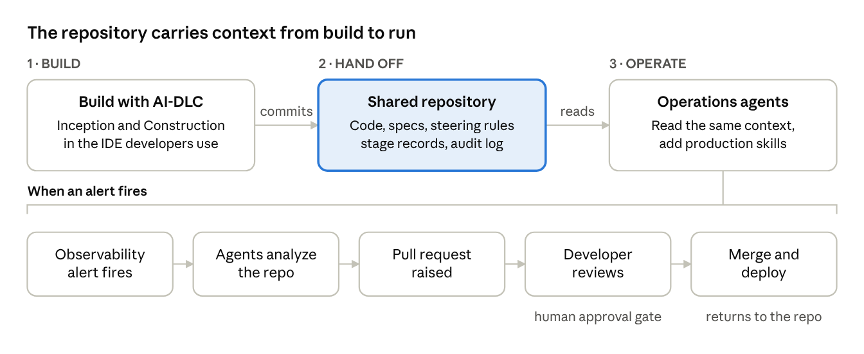
AI-DLC writes the context once at build time. The operations agents read it on every alert, and every fix still passes through a developer’s review.
We’ve built this pattern into our own methodology: the Presidio Self-Evolving Application approach. “Self-evolving” is a big phrase, so it’s worth being precise. The application changes only through reviewed pull requests, the same as it always has. What evolves is the operations layer. A self-reflection agent audits the reasoning behind each action and feeds what it learns back into the knowledge the agents draw on, so triage and root cause analysis get sharper with every incident they work. No agent merges or deploys its own change.
Where this fits with AWS operations tooling
AWS isn’t standing still on the day after deploy – those describing it as untouched territory are behind on their reading. The second major version of the open-source AI-DLC workflows added an Operations phase covering deployment, monitoring and closing the loop back to development. AWS DevOps Agent, generally available since March 31, 2026, investigates incidents by correlating telemetry, code and deployment data across AWS, multicloud and on-premises environments.
We see these as complementary layers. AI-DLC sets up how an application is deployed and observed. An investigation agent narrows down what went wrong. The pattern described here focuses on the step after that: turning a diagnosis into a tested code change, for the life of the application, inside a governance model the customer’s security and operations teams can sign off on.
That last part is a big deal. Most enterprise estates aren’t single-vendor, and most operations teams already have an observability stack, an ITSM process and change-approval rules they aren’t going to abandon. An operations layer that plugs into what’s there, rather than replacing it, is the one that gets turned on.
Autonomy has to be earned
When we talk with engineering leaders about agents in production, three questions come up almost every time. How do we use this safely? How do we trust what it produces? How do we keep the costs from running away?
Those are the right questions, and they can’t be answered by a promise. They’re answered by architecture. Every Presidio Self-Evolving Application deployment runs under a governance model we call Safe Autonomy, seven principles set at deployment time and enforced at runtime: action safelists, cost governance, human-in-the-loop escalation, full auditability, minimal authority, validated execution and grounded reasoning.
In practice that means work escalates through tiers. A triage agent classifies incoming alerts and tickets and matches them to patterns it already knows. Any code change it suggests goes through the same pull request review as everything else. A root cause agent investigates in read-only mode. Only then does a remediation agent build a fix, and it does that in a sandbox, not in production. A cost-control agent caps model spend per ticket, so one stubborn incident can’t burn a quarter’s budget. Every action is logged.
And nothing ships without a person approving it. Requiring human review on every pull request is slower than letting an agent merge its own fix. That’s deliberate. Teams should widen the range of tickets agents work on only as the audit trail earns it. The pull request review stays in place regardless.
There’s a second honest limit worth calling out. This pattern is only as good as the context it inherits. An application built with thin specs and vague requirements hands its operations agents thin, vague context. AI-DLC raises that floor considerably, but the quality of what a team writes down at build time still shows up in production, months later, at the worst possible moment.
What context is worth
One of the clearest signals we’ve seen came from an engagement that had nothing to do with AI-DLC. A fast-growing industrial services company was running unstable on-premises systems, with poor application visibility, heavily manual processes and little in-house cloud expertise. Its custom applications were business-critical, and most of what anyone knew about how they worked was locked inside the code itself.
We introduced agents that ingested and analyzed the source code and proposed fixes for coding issues – reviewed and merged by the team’s engineers – to help stabilize the core business applications. The company lowered its operational costs by 25% by shortening analysis cycles and cutting the effort hours needed to maintain and modernize those applications. Its development throughput metrics improved by more than 80%, as technical debt came down and the legacy estate stabilized. The company’s CIO credited the work with “unlocking the knowledge inside our custom software.”
Here’s the catch, and it’s the point of this post. Much of that effort went into extracting context the original builders never wrote down. With an application built through AI-DLC, the context is already sitting in the repository on day one. The extraction step goes away, and the operations agents start where that engagement had to work to get to.
What this means to the business
When the application’s intent travels with the code, the payoff reaches well beyond the engineering team. For the business, it shows up in five places:
- Faster recovery. Responders start from the application’s documented intent instead of rebuilding it mid-incident.
- Lower cost to run. Analysis cycles shrink and fewer effort hours go to maintaining and modernizing applications.
- Less key-person risk. Knowledge lives in the repository, not in the head of an engineer who has since moved on.
- Scale without matching headcount. Alert volume is growing faster than teams. Agents handle known patterns and prepare fixes, while people make the decisions.
- Governance leaders can sign off on. Every action is logged, every change is reviewed and cost is capped.
Where teams can start
For organizations already running AI-DLC, or planning a first workshop, the day-after question is easier to answer early than late. A few practical steps:
- Pick one application. Choose something built or being built with AI-DLC that matters enough to have real alerts, and look at how much of its intent actually made it into the repository.
- Measure the baseline first. Record mean time to resolution, alert volume and on-call hours before any agent goes live. Without a before, there’s no after.
- Write the safelist before the agent. Decide which ticket types agents may act on, what they may touch and when they must hand off to a person.
- Connect what you already have. Point the operations layer at the observability and ticketing tools the team uses today. A pilot that starts with a platform migration rarely finishes.
- Keep the pull request gate. As the audit trail builds, expand which ticket types agents work on, but keep a human approving every change.
The day after, by design
AI-DLC is built on the idea that structure and human judgment get more out of AI than speed alone. That idea holds just as well on the other side of deploy.
The next time an alert fires at 3 a.m., the first responder doesn’t have to start from a stack trace. It can start from the same specs the builders wrote, work the problem inside rules the team set in advance and leave a developer a tested pull request to review in the morning, instead of a page in the middle of the night.