
Author’s note: this paper was originally written several years ago as a case study of a single hospital beginning its AI journey. It has since been revised to speak to healthcare organisations more broadly, replacing organisation-specific detail with general industry examples and evidence, while preserving the original analysis, structure, and sources.
VP Sales Operations UK at Presidio
Introduction
The focus of this study is to explore the implications of Artificial Intelligence (AI) within the healthcare industry, and to examine the opportunities, challenges and implications associated with adopting AI across hospitals and healthcare organisations.
Initial thoughts turn to medical imaging, patient diagnosis and the multitude of patient records and healthcare data, but the use of AI can be felt across the industry, from facial recognition for physical security to machine learning for cyber security and the streamlining of repetitive day-to-day processes.
These improvements allow staff to focus on what is important: patient outcomes, care, and experience. Many healthcare organisations already have some AI-enabled software in place, such as security camera systems with facial recognition or next-generation antivirus solutions, but these are not the focus of this paper.
Healthcare and social care are lagging behind many other industries in their use and adoption of AI, which will be probed and analysed throughout this paper. Identifying a strategy and approach to breaking down the barriers facing healthcare organisations is key to demonstrating the value of implementing AI.
To analyse each relevant area, this study is broken down into three streams: Business Services, Clinical Services and Patient Experience, exploring the opportunities, challenges and implications associated with each.
Maturity Level
To create a strategy and begin the journey of exploring a healthcare organisation’s AI capability, the baseline, or existing position, from which the journey begins must first be understood.
There are different maturity level models available to baseline an organisation, but for simplicity, and because it is widely referenced across industry, the Gartner model is used here.
Gartner state that:
“To establish a strategy, measure your organisation against the AI maturity model. This model can be used as a framework to identify where your organisation is on the potential growth curve, communicate with management and decide what steps need to be taken. No matter where your organisation is on the map and how far it has to go, ensure that strategies are highly adaptive, with ample room for experimentation.”
(Kasey Panetta et al., 2019) [1]
The following diagram displays Gartner’s AI Maturity Model:
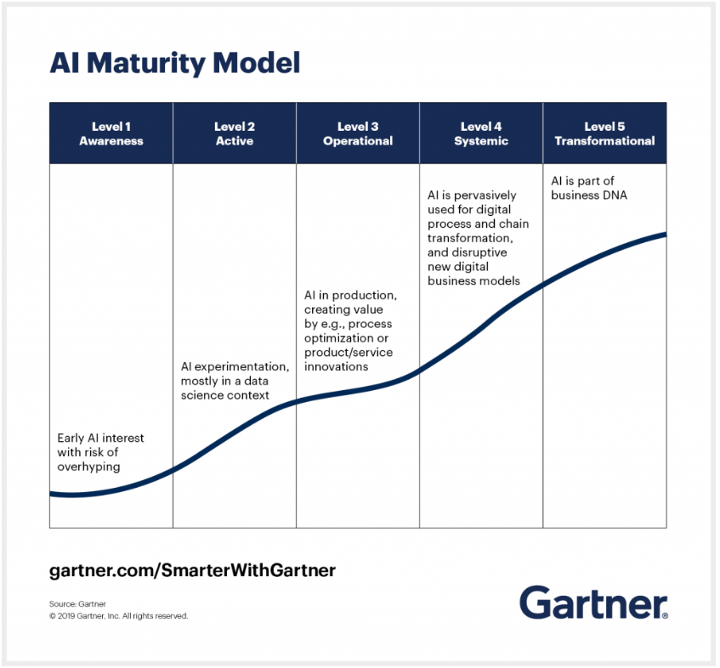
Even where a healthcare organisation already has software in place that uses Machine Learning (ML), Deep Learning (DL) or other AI services, the lack of a technical (and specifically AI) strategy underpinning progress often means such organisations fall into “Level 1 Awareness”. It is positive that discussions have begun in the AI space across the sector and there is a growing appetite to progress, but an organisation that assumes it has reached “Level 2 Active” when it has not will run into problems building momentum with its AI approach.
Strengths, Weaknesses, Opportunities, Threats (SWOT)
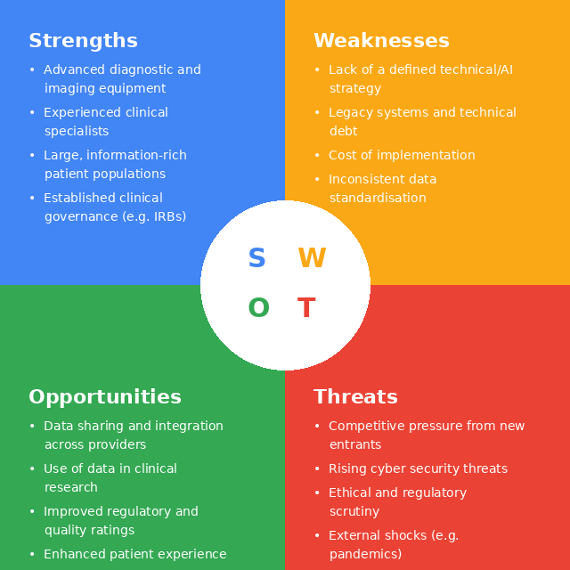
To understand the opportunities available to healthcare organisations and what could prevent the realisation of a solid AI strategy, a SWOT analysis of a typical healthcare provider helps to visualise and provide a foundation for discussions with management.
Core Exploratory Areas
The following section explores core areas in understanding AI, how it impacts healthcare organisations, and areas which need to be incorporated into a transformation strategy.
Digital Transformation
When considering digital transformation, there needs to be a cultural shift in the thinking behind strategies such as AI and technology. Many healthcare organisations still view IT as a cost burden rather than an enabler for the business, when the mindset needs to treat an AI strategy as business-wide, not something contained solely within IT. This cultural challenge is often the first hurdle healthcare organisations face in adopting an AI approach.
Robotic Process Automation
Robotic Process Automation (RPA) can help hospitals and other healthcare organisations streamline repetitive tasks, freeing up more time for patient care. This does not replace existing staff but complements their working practices, supporting the wider strategic goal of delivering an excellent patient experience.
Cognitive Insight
The volume of data contained within the healthcare industry is not only tremendous in scale, but also some of the most valuable, both for positive medical insights and for malicious actors who see the worth in obtaining this information. It is estimated that approximately 30% of the world’s data is being generated by the healthcare industry (Andrew Callaway et al., 2019) [2], and this continues to grow exponentially. This presents both opportunities and challenges for healthcare organisations in how they handle and process this data.
Cognitive Engagement
Cognitive engagement is an interesting area to explore when discussing AI and the healthcare sector. Although the benefits are clear for all to see, can patients trust the use of chatbots and other tools in situations where there would traditionally be human-to-human interaction?
Industry Development
AI is being widely used across the healthcare industry at varying levels of maturity, though many individual hospitals and healthcare providers’ own AI strategies remain in their infancy. Natural Language Processing (NLP) is widely used by consultants and secretaries to dictate patient diagnoses and act as personal voice assistants. Other products are used to check symptoms, and some can help with the early diagnosis of critical diseases such as cancer and blood diseases. This does, however, bring with it ethical challenges.
People, Process and Technology
A key part of any AI strategy, People, Process and Technology should be clearly laid out and identified to provide firm foundations. Without this, many organisations pursuing similar transformations have failed. This usually occurs when technology is approached first, leading to unnecessary overspend and unused products and systems. To enable a truly successful digital transformation, this must be planned strategically.
Ethical, Societal and Legal Implications of Artificial Intelligence
Although AI has the potential to drastically improve healthcare, there are also ethical and legal implications and considerations. Do patients have the safest journey when, for example, software uses algorithms to identify cancer treatment? A prime example is a high-profile incident involving IBM Watson for Oncology, which recommended “multiple examples of unsafe and incorrect treatment recommendations” (Jennings Brown, 2018, para. 1) [3], which could have been fatal to patients. Given the volume of personal, sensitive and confidential identifiable information related to patients, will algorithms introduce bias based on the information a patient provides? Liability also becomes complex and makes the adoption of AI more difficult, because should an incident such as the IBM Watson case become a reality, confidence in AI falls. GDPR contains a specific requirement that “the data subject shall have the right not to be subject to a decision based solely on automated processing, including profiling, which produces legal effects concerning him or her or similarly significantly affects him or her” (ICO.org.uk, Article 22(1)) [4], so there must be a level of human interaction, rather than complete reliance on automation, to avoid GDPR implications in the UK.
Core Exploratory Areas Summary
Healthcare is a complex space in which to initiate an AI strategy, not only because many healthcare organisations are starting from “Level 1” of the maturity model, but because of the ethical and legal implications associated with AI. The next phase of this study aims to separate the core organisational areas out and combine them into a strategy to achieve the target state of providing a greater patient experience. The transformation required could be considerable, but it needs an underpinning and solid strategic vision with buy-in from across the organisation.
Capability Strategy & People, Process and Technology
To ensure a successful AI transformation, these core areas need to form the foundations that complement the existing business strategy, in turn achieving the intended outcomes of the target state. A typical healthcare organisation’s business strategy might include:
- Provide the greatest patient experience and outcomes
- Attract and retain the best consultants and medical staff
- Lead the way across clinical specialties
- Minimise financial losses through broken processes so that money can be reinvested in patient care
An interesting way of measuring AI adoption within different industries is by viewing job postings which reference AI, shown in the following diagram (Squicciarini, M. and H. Nachtigall, 2021) [5]:
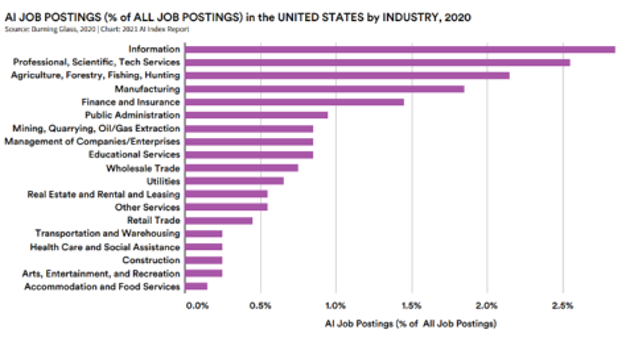
Healthcare is behind other industry sectors when it comes to identifying people with the relevant skill set, which affects the people side of the capability equation. This raises the question: do healthcare organisations have the relevant competence to adopt AI? Have staff become so accustomed to their existing ways of working that they will resist an AI strategy out of fear of change, or because of misconceptions around GDPR and ethics? How difficult will securing management buy-in be given existing habits and the need to adapt to such change? The concept of “little AI” is likely to be the correct initial strategy from which to progress from an existing baseline state. Starting from “Level 1” on the maturity model, and given some of the statistics cited in this paper, a too-aggressive strategy risks failing the transformation before it has started. Demonstrating value by improving existing operational processes can help propel the strategy forward, but it must be done in the right way. The following table sets out what makes “little AI” good or bad (Jim Euchner, 2019) [6]:

Process is important, and the correct governance models need to be in place to ensure the best outcomes. A governance process, namely the Institutional Review Board (IRB), is already used widely in healthcare, and the National Cancer Institute defines it as:
“A group of scientists, doctors, clergy, and patient advocates that reviews and approves the detailed plan for a clinical trial. IRBs are meant to protect the people who take part in a clinical trial. They check to see that the trial is well designed, legal, ethical, does not involve unneeded risks, and includes a safety plan for patients. There is an IRB at every health care facility that does clinical research, and every trial is reviewed by an IRB before the trial begins.”
(National Cancer Institute, Cancer Terms Definition) [7]
In many healthcare organisations, the foundations of the IRB model have informed the creation of Architecture Review Boards (ARBs), which assess new technology requests, changes and implementations against core governance principles, with the business strategy providing the platform for decision-making. Where such a board already exists, is mature, and draws stakeholders from across the organisation, AI can be included as a natural extension of this existing framework.
Although the underlying technology is capable of integrating and utilising AI, healthcare organisations need to lay foundations so that the correct skills are identified and governance is used to communicate and demonstrate the value of AI, helping providers gain a competitive edge over existing and new entrants to the market.
Business Services
Business services functions, including Human Resources (HR), Finance and Information Technology (IT), are areas where AI can improve current processes across healthcare organisations.
Human Resources
AI can benefit HR departments in healthcare organisations in many scenarios, but the primary focus here is on reducing repetitive tasks so that HR staff can focus on the people aspect of their role. There are multiple areas in which Artificial Intelligence can complement the HR function, including:
- Recruitment
- Joiners, movers and leavers
HR teams are relied upon to give staff the empathy and personal touch they need throughout their working lives, yet are often inundated with manual, repetitive tasks. Recruitment can be made easier with AI when sourcing the right candidates, and between August and October 2021, the health sector had the highest number of vacancies of all industries (BBC.co.uk, 2021) [8]:
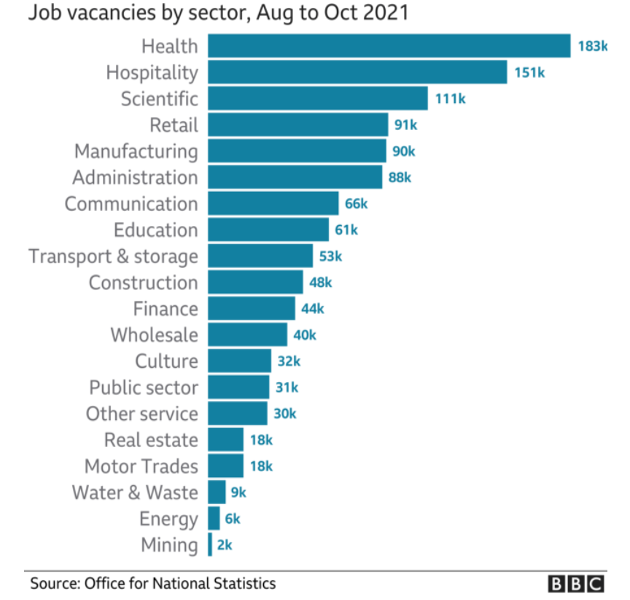
With low adoption of AI in health but a high number of vacancies, could using AI within HR departments significantly help recruitment and identify the right people more quickly, while freeing HR staff to focus on other tasks? Ethical concerns may arise, as AI can be seen as introducing bias in some instances, particularly with sensitive information (gender, ethnicity, age, and so on) obtained during recruitment, though this depends heavily on how the data is collated and how the algorithms are designed.
Finance
Finance departments in many healthcare organisations currently deal with legacy systems and processes, many of which take up more time than necessary and need daily, weekly and monthly input from staff to execute. Robotic Process Automation can be applied to many areas that are currently pain points, freeing staff to focus on more strategic work, including:
- Account reconciliation
- Patterns in patient payment and whether these have been completed
- Detecting inconsistencies or errors in payments
- Cohesion between departments such as stores and medical stock
These tasks currently present mundane processes which often lead to a loss of revenue due to user error, and applying Robotic Process Automation can help achieve improved working practices, fewer mistakes, and a complement to, rather than a replacement of, existing staff.
Information Technology
AI can be applied to improve current IT processes, and with the business strategy pillar of attracting and retaining the best consultants and medical staff in mind, which in turn supports the aim of providing the greatest patient experience and outcomes, improving the service experienced by medical staff is the focus here.
Using chatbots, AI can be leveraged to deal with routine tasks and allow IT service professionals to focus on more complex and difficult situations. Chatbots can reduce ticket backlogs and improve response rates. There are many situations within traditional IT service teams where calls are missed or there are delays in resolving healthcare professionals’ problems, so chatbots can provide increased productivity and greater satisfaction. Advances in conversational AI and Natural Language Processing mean repetitive queries can be understood by a chatbot, providing a convenient way for staff across a healthcare organisation to resolve their problems.
The challenge emerges in the interaction between users and chatbots. Frustration can run high when calls are logged, and service desk operators need to be empathetic, so can the adoption of a chatbot provide the standard of service expected by clinical staff?
Clinical Services
Improvements to Business Services through AI have a knock-on impact on Clinical Services and demonstrate real value when implementing an AI strategy. AI within the clinical space, however, can also cause positive disruption to standard working practice.
It is estimated that misdiagnosis causes up to 80,000 hospital deaths each year and results in billions of dollars in wasted medical spending (Asheesh Mehra, 2020) [9]. Although misdiagnosis can happen for many reasons, the volume of data required to diagnose a patient plays a significant part, with some imaging platforms capturing hundreds or even thousands of pieces of data for a medical specialist to review. AI can assist by analysing this data and allowing the medical specialist to review and validate the outputs.
Ethics is a major consideration for a solution like this, and a good example concerns radiologists who, through their diagnosis of medical imaging, provide input that can be used in “supervised learning, for example in convolutional neural networks” (Matthew E. Fenech and Olly Buston, 2020) [10]. A paper called Ethics of Artificial Intelligence in Radiology, jointly published by the American College of Radiology, European Society of Radiology, Radiological Society of North America, Society for Imaging Informatics in Medicine, European Society of Medical Imaging Informatics, Canadian Association of Radiologists, and American Association of Physicists in Medicine (J. Raymond Geis et al., 2019) [11], discusses these ethical challenges in detail, particularly around bias in the categorisation of medical images and the impact this may have on AI software.
For Clinical Services to embrace AI, there are many considerations that should be worked into the key principles of a governance process, such as:
- What level of training is required? Clinical and non-clinical staff will require different types of training to upskill with AI
- What risks are associated with using AI, categorised by patients and staff
- Is the data being used accurate, and if not, what needs to be done to cleanse it
- Monitoring the impact of using AI once implemented, to ensure it is working as expected
Patient Experience
This study discusses the opportunities and challenges associated with AI adoption in healthcare organisations, beginning with smaller steps to demonstrate value, with a view to progressing into more comprehensive AI implementations in future. The goal of this strategy is to ensure that the primary strategic aim of any healthcare provider, to provide the greatest patient experience and outcomes, is realised.
The Care Quality Commission (CQC), the organisation that independently regulates the quality of health and social care in England through monitoring and inspections, sets out many statements about what patients should expect from their care. One which is intrinsically linked to this paper, and has influenced this AI strategy, is that patients should be “involved in decisions about your care and staff spending time talking with you” (CQC, 2017) [12].
Using AI to improve repetitive tasks and lengthy processes, as well as those that help medical professionals with diagnosis and the volumes of data they must review, allows medical staff to focus on their patients and “spend the time talking with them.”
Conclusion
For many healthcare organisations, the journey with AI begins at “Level 1”, yet the benefits could be hugely impactful, making a real difference not only to clinical and non-clinical staff but to the overall patient experience. There are many opportunities in using AI across healthcare, but the challenges and implications discussed throughout this study require a solid governance foundation and a phased approach to move towards the target state. Trying to change too much, too quickly, risks the transformation failing, particularly given how embryonic AI adoption still is across much of the sector. But with the right approach, and buy-in from the relevant stakeholders, this could be a major success, freeing medical staff to focus on supporting both colleagues and patients.
Get the Presidio AI Readiness Report
Most IT leaders want AI, but risk and readiness gaps are holding them back. This report, backed by a survey of 1,000+ CIOs, CTOs, and IT decision-makers, shows you why, and how to move past it.
"*" indicates required fields
Reference List
[1] Kasey Panetta et al., (2019) ‘The CIO’s Guide to Artificial Intelligence’, Gartner, Assess AI Maturity, para. 2
[2] Andrew Callaway et al., (2019), RBC Capital Markets | The healthcare data explosion, A Healthy Outlook for Data, para. 1
[3] Jennings Brown (2018), ‘IBM Watson Reportedly Recommended Cancer Treatments That Were Unsafe and Incorrect’, para. 1
[4] Information Commissioner’s Office, ‘Guide to Data Protection, Guide to the General Data Protection Regulation (GDPR), Individual rights, Rights related to automated decision making including profiling’, [Article 22(1)]
[5] Squicciarini, M. and H. Nachtigall (2021), ‘Demand for AI skills in jobs: Evidence from online job postings’, OECD Science, Technology and Industry Working Papers, No. 2021/03, OECD Publishing, Paris, https://doi.org/10.1787/3ed32d94-en.
[6] Jim Euchner (2019) Little ai, Big AI – Good AI, Bad AI, Research-Technology Management, 62:3, 10-12, DOI: 10.1080/08956308.2019.1587280
[7] National Cancer Institute, ‘Dictionary of Cancer Terms, Definition of IRB’
[8] BBC (2021), ‘Job vacancies: Which sectors are short of workers?’, Who’s hiring?, https://www.bbc.co.uk/news/explainers-53685650
[9] Asheesh Mehra (2020), ‘How AI Is Transforming Healthcare’
[10] Fenech Matthew E., Buston Olly (2020), ‘Frontiers | AI in Cardiac Imaging: A UK-Based Perspective on Addressing the Ethical, Social, and Political Challenges | Cardiovascular Medicine’ (frontiersin.org), DOI=10.3389/fcvm.2020.00054
[11] Geis JR, Brady AP, Wu CC, Spencer J, Ranshaert E, Jaremko JL, et al. ‘Ethics of artificial intelligence in radiology: summary of the joint european and north american multisociety statement’, Can Assoc Radiol J. (2019) 293:436–440. doi: 10.1148/radiol.2019191586
[12] Care Quality Commission, ‘What can you expect from a good hospital?’ You can expect a good hospital to be caring because…. (cqc.org.uk)