
AIOps isn’t a new concept.
For the last decade, IT teams have used AI/ML for change detection, correlation, prediction, and alerts. The upside: teams could more easily identify, understand, and mitigate critical issues. The downside: teams often needed time and extensive skills to build the necessary workflows for remediation.
But, thanks to modern advances in AI – including GPT capabilities – Presidio and Red Hat are making it easier than ever for organizations to manage their infrastructure and quickly find and remediate issues.
Meet Presidio’s Intelligent Ops Framework, integrated with Red Hat Ansible Automation Platform. Designed for brownfield environments, Intelligent Ops with Presidio and Red Hat converges AIOps, SecOps, and intelligent automation into a unified operating mode. With AI agents doing the heavy lifting across infrastructure orchestration, threat detection, compliance, and self-healing, and powerful automation taking the manual work out of updates, IT teams have a secure, governed way to manage their environments, infrastructure, and assets.
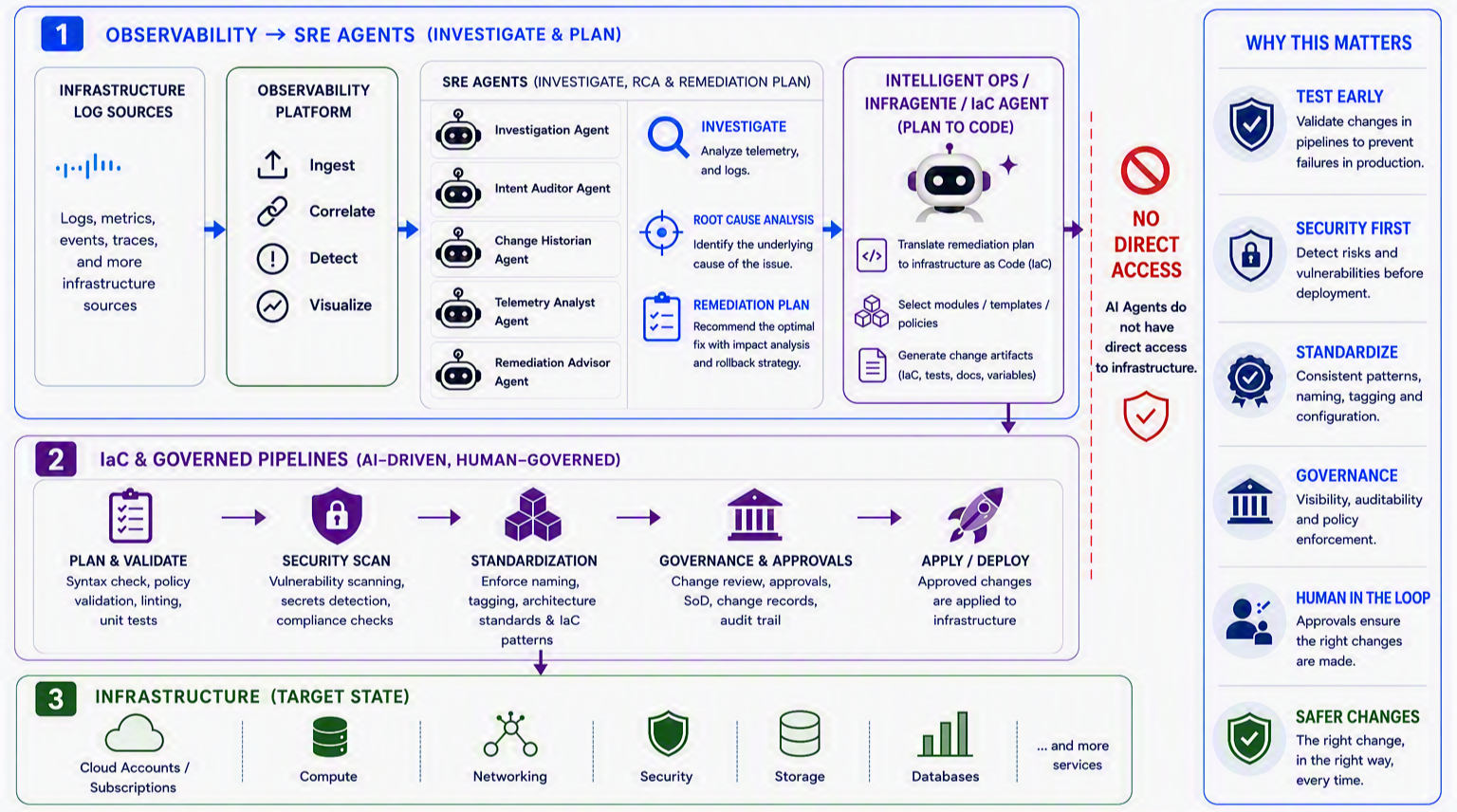
Intelligent Ops in action
Intelligent Ops reduces manual effort, cuts costs, and delivers real-time visibility when and where it matters. Let’s walk through a fictional case to see how this powerful platform would address a common event.
The event: A scheduled ServiceNow change is implemented at 2am. The change inadvertently causes a network connection failure, but load balancing keeps the service available, so the problem isn’t immediately apparent. The first indication of an issue comes from user complaints of slow service.
Traditional remediation: In the past, highly skilled network administrators would use AIOps capabilities and their domain expertise to research, diagnose, and remediate the issue. The work could require significant time and specialized skills in system configuration, script writing, and solution documentation.
Intelligent Ops: With Intelligent Ops, a newtork expert uses plain language in a chat interface to describe the challenge – slow service – and command the program to find and propose remediation of the issue. AI agents do the heavy lifting of finding the issue, reasoning through the challenge, proposing remediation, and developing infrastructure-as-code. Validation and execution are also automated, with a human always in the loop.
Detect: A SRE agent compares the current state of the network against a network infrastructure source of truth, such as NetBox. This process reveals a downed connection.
Investigate: The SRE agent finds the root cause of the downed connection – a misconfigured change in ServiceNow.
Propose remediation: The SRE agent proposes a fix for the issue, including an impact analysis and rollback strategy. An IaC agent translates the plan into infrastructure-as-code, selecting modules, templates, and policies, and generates change artifacts.
Validate: Automated pipelines provide a deterministic process for validating and applying the infrastructure-as-code changes to the infrastructure, ensuring security, compliance, standardization, and governance guardrails.
Approve: Once agents have found and proposed a solution to the downed connection caused by the ServiceNow change, and the proposed remediation has been reviewed and validated, a human must approve the update.
Execute: Ansible Automation Platform executes the predefined remediation workflow, the connection is restored, and service returns to normal speed.
Notice that, with Intelligent Ops, AI takes on the majority of the technical work that once bogged down administrators, but it does not directly touch the infrastructure. AI agents request changes through IaC, pipelines, and guardrails, maintaining safety, consistency, and control, while keeping infrastructure secure. Ansible Automation Platform executes the predefined workflow only once a human has specifically approved the changes. Human oversight is critical to ensuring that the right changes are made in the right way, every time.
Take the next step in infrastructure management with Intelligent Ops
Where traditional automation executes tasks, AIOps monitors and correlates events, and SecOps investigates and responds to threats, Presidio’s Intelligent Ops Framework unifies all three: AI agents orchestrate infrastructure through natural language commands, correlate events across domains for rapid root-cause analysis, detect and contain security threats automatically, self-heal failed deployments, and generate compliance reports on demand. Add in Ansible Automation Platform, which takes the manual work out of making the updates in the environment, and you have a smart way to upgrade your infrastructure management and keep your team focused on what they do best – running your environment.
Contact us today to get started with Presidio’s Intelligent Ops Framework.